Native Plant Spotlight: Bigleaf Magnolia (Magnolia macrophylla)
By Leslie Kimel
Originally printed in The Call newsletter, Volume 13, Number 2
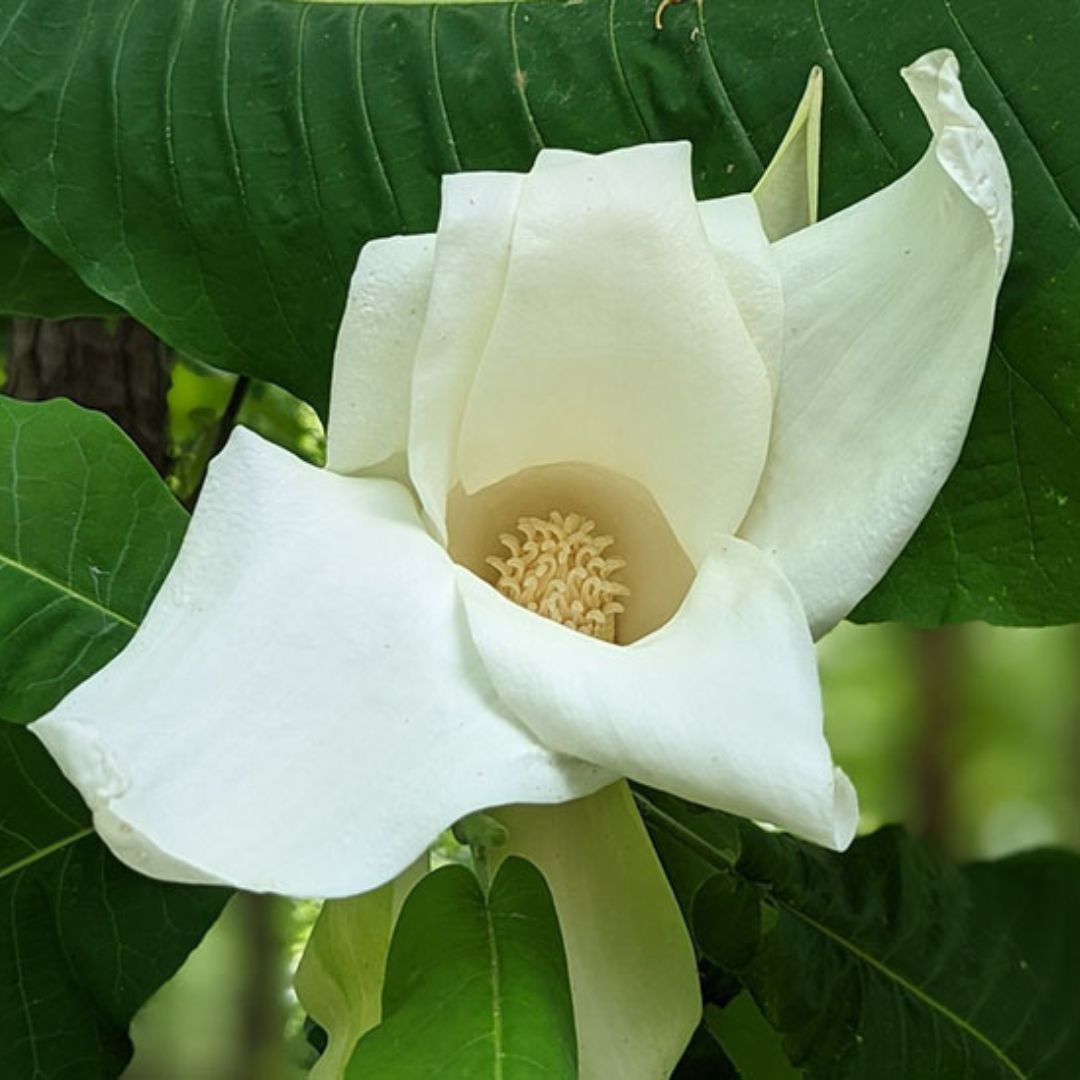 Want to add a bold, tropical look to your Georgia garden? Well, instead of planting that banana tree, try a bigleaf magnolia. With its giant bright green floppy leaves and huge fragrant ivory flowers, this 20- to 40-foot Georgia native is guaranteed to put you in mind of steamy, sultry, faraway places – lush jungles and tropical rainforests. Come across a rare wild-growing grove in a rich wooded cove or ravine and chances are you’ll feel like you’ve stepped back into the days of the dinosaurs.
Bigleaf Magnolias are pollinated primarily by flower beetles. Beetles can’t see very well, but they’ve got a pretty good sense of smell. They are attracted by the magnolia flowers’ strong fragrance and rewarded with food – in this case, plenty of pollen and flower parts (magnolias have extra just for them!) While feeding on a flower, a beetle becomes covered with pollen, and when it moves on to the next flower, it pollinates the plant.
Bigleaf’s extravagant, beetle-pleasing blossoms measure up to 15 inches across and appear in May and June, after foliage. Composed of six long, fleshy, concave “tepals” (undifferentiated petals and sepals), they are grand, creamy bowls of fragrance that rest among the leaf whorls in the upper canopy. Whenever I’ve been lucky enough to spot a tree in bloom, I’ve always been reminded of my grandmother’s china – her big buttermilk-colored serving dishes and soup tureens.
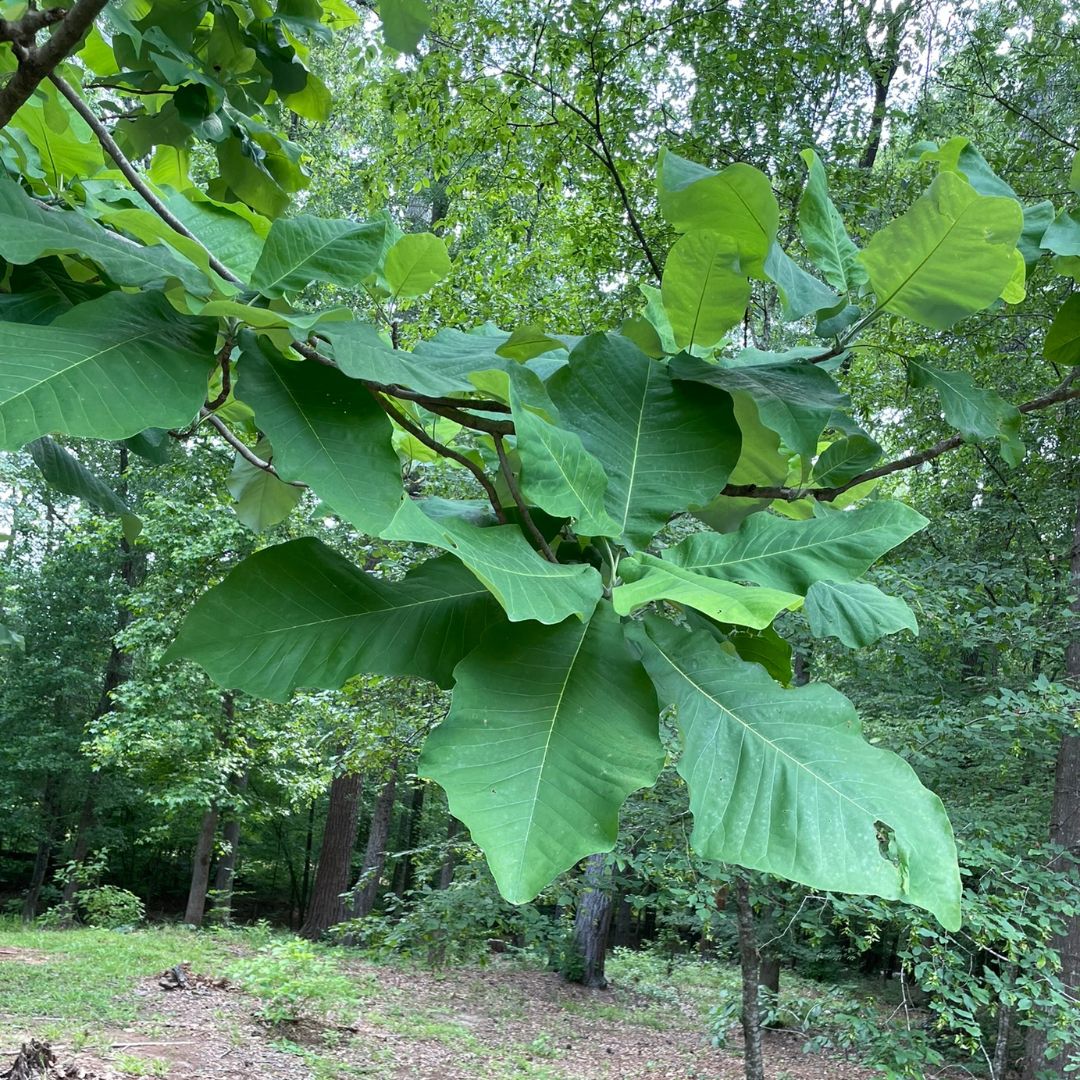
After the flowers fade, the enormous leaves (up to three feet long and a foot across) take center stage. In summer the leaves get so big and heavy they make the branches sag! Each leaf is bright green on top and silvery and downy on its underside, with wavy edges and “earlobes” at its base. Upon discovering the bigleaf magnolia in 1796 (in Gaston County, North Carolina), Andre Michaux, the famous French botanist and explorer, described the experience in his journal: “…Remained all day to pull shoots from a new Magnolia with very large leaves…” “Very large” is an understatement; bigleaf magnolia has the largest simple leaf of any species native to North America.
 In fall, rose fruits ripen, loaded with scarlet seeds. The three-inch fruits are quite eye-catching and ornamental, and the oily, protein-rich seeds, which hang from the fruits by filaments, provide food for yellow-bellied sapsuckers, red-eyed vireos, towhees, and eastern kingbirds. The cones and leaves drop in late fall, but the smooth gray bark, sculptural branches, and big silvery, velvety leaf buds offer plenty of winter interest.
Bigleaf magnolia occurs in isolated populations in rich mesic woods in the Piedmont and upper Coastal Plain of Georgia, often in conjunction with American beech (Fagus grandifolia). Now available at specialty nurseries, bigleaf makes a great addition to the woodland garden, where it provides bold contrast to the more delicate textures of lacy ferns and wildflowers. For best results, plant in rich, undisturbed woodland soil that is loose, deep, well drained, and slightly acidic. In the wild, this is an understory tree, so site it in full to part shade, in a protected spot where the wind won’t tear the leaves. After that, it’s pretty much maintenance-free – just give it a little room to spread out.
Sure beats a banana.
Recent Comments